Posts

Choosing the Right Core: RO vs. UF in Beverage and Drinking Water Production

In the liquid food and beverage industry, water is more than just an ingredient—it is the foundation of product quality, safety, and taste. For producers of bottled mineral water, fruit juices, and even edible oil processing facilities, selecting the appropriate filtration technology is a critical decision that impacts both the final product profile and long-term operational costs (OPEX). At ShineDew, we specialize in two primary membrane technologies: Reverse Osmosis (RO) and Ultrafiltration (UF). Understanding their distinct roles is key to optimizing your production line.

Reverse Osmosis (RO): The Standard for Absolute Purity
Reverse Osmosis is widely regarded as the gold standard for achieving high-purity water. By utilizing a semi-permeable membrane with incredibly fine pores, RO systems remove up to 99% of dissolved salts (TDS), organic compounds, bacteria, and viruses.
For manufacturers of bottled purified water or reconstituted fruit juices, RO is the indispensable choice. It ensures a “blank canvas” by stripping away minerals that might interfere with the precise flavor profile of a beverage. In regions where raw water has high salinity or hardness, our RO systems provide a stable, consistent feed-water quality that protects downstream equipment—like high-speed fillers and labeling machines—from scaling and corrosion.

Ultrafiltration (UF): Preserving Nature’s Minerals
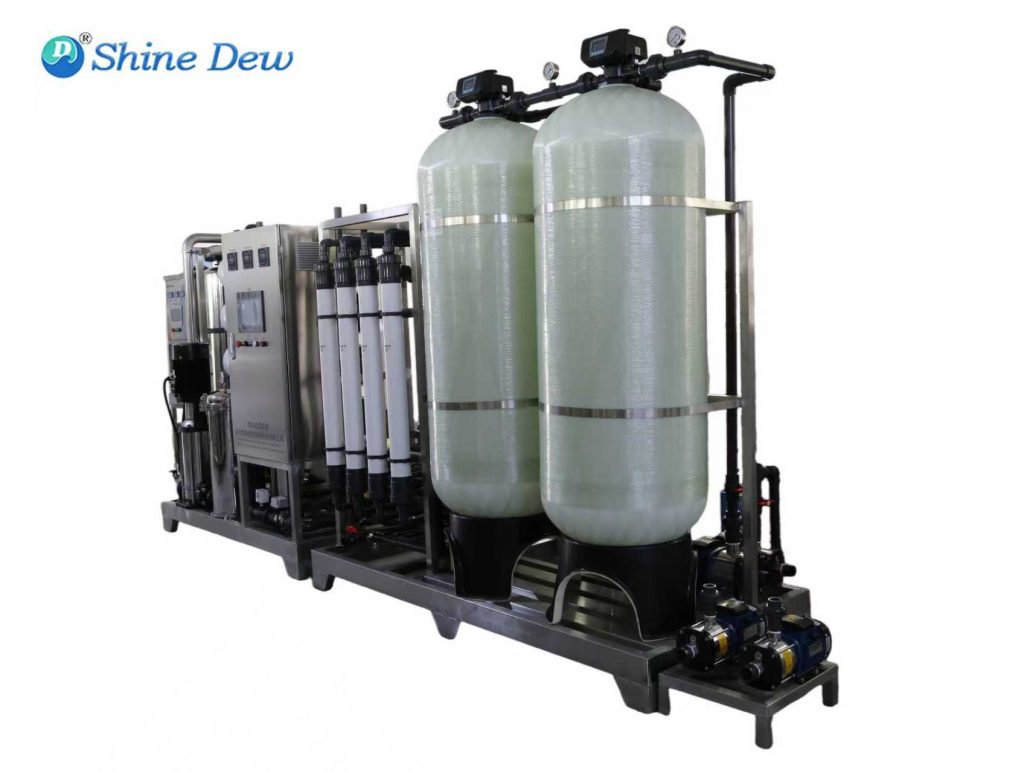
Unlike RO, Ultrafiltration operates at lower pressures and utilizes membranes with a larger pore size (Molecular Weight Cut-Off). While UF effectively removes suspended solids, colloids, and harmful microorganisms (such as Giardia and Cryptosporidium), it allows essential dissolved minerals like calcium, magnesium, and potassium to pass through.
This makes UF the ideal technology for natural mineral water production. Today’s health-conscious consumers increasingly demand water that retains its natural electrolyte balance. A UF-based production line allows you to market a product that is microbiologically safe while maintaining the “source-origin” mineral profile. Additionally, because UF operates at lower pressures, it typically offers lower energy consumption compared to RO systems.
Making the Strategic Choice
The decision between RO and UF should be driven by two factors: your source water analysis and your market positioning.
If your raw water has a high TDS or if you are aiming for a ultra-pure product, RO is the logical investment. If you have high-quality spring water and wish to preserve its natural health benefits, UF provides a high-efficiency, cost-effective solution. In many advanced production lines, we even see these technologies used in tandem—UF as a robust pre-treatment to extend the life of the RO membranes.
At ShineDew, we don’t just supply equipment; we engineer solutions. Whether you are scaling a 1,500 BPH line or managing a massive juice production facility, our technical team is ready to help you calibrate the perfect filtration core for your business.
Optimizing Performance: A Comprehensive Guide to Extending the Service Life of Industrial RO Membranes

In the realm of industrial water treatment, the Reverse Osmosis (RO) membrane is often referred to as the “heart” of the system. Whether in seawater desalination, power plant boiler feed water, or wastewater reuse, the efficiency of these membrane elements directly dictates the operational expenditure (OPEX) of the entire facility. However, many operators face the challenge of premature flux decline and frequent replacements. Extending the service life of industrial RO membranes is not merely about reactive cleaning; it is a systematic discipline that begins with meticulous pre-treatment and ends with disciplined operational monitoring.

The first line of defense is undoubtedly the pre-treatment system. Most membrane failures are rooted in inadequate feed water quality. Monitoring the Silt Density Index (SDI) is paramount; an SDI15 value exceeding 5 is a precursor to rapid colloidal fouling. For instance, a chemical fiber plant we collaborated with in Southeast Asia initially struggled with high replacement costs. Upon investigation, we found that their multi-media filters were bypassing fines during backwash cycles. By optimizing the coagulation dosage and ensuring the SDI remained consistently below 3, the plant extended its membrane lifespan from 18 months to over 3.5 years. This highlights that the longevity of an RO element is often determined before the water even touches the membrane surface.

Beyond physical filtration, chemical stability within the system is crucial. Scaling, particularly from calcium carbonate or sulfate, occurs when the concentration of salts exceeds their solubility limits. Utilizing high-quality anti-scalants and maintaining the correct pH levels are essential. Furthermore, operators must be vigilant against “chemical oxidation.” Residual chlorine from the disinfection stage can cause irreversible damage to the polyamide layer of the membrane. Implementing a robust dechlorination process using sodium bisulfite or activated carbon filters is non-negotiable for preserving the structural integrity of the membrane.

Operational parameters such as cross-flow velocity and recovery rates must also be managed with precision. Operating a system at a recovery rate higher than its design specification may seem efficient in the short term, but it significantly increases the risk of concentration polarization. This phenomenon leads to a higher concentration of solutes at the membrane surface, accelerating both scaling and organic fouling. We recommend a “Normalization” approach to data tracking. By comparing current flow and salt rejection against the initial baseline—adjusted for temperature and pressure—operators can identify performance drifts early.

Finally, the timing of Clean-in-Place (CIP) is a decisive factor. A common mistake is waiting for a 20% or 30% drop in normalized permeate flow before initiating cleaning. By that stage, the foulants are often compacted, making them nearly impossible to remove completely. The industry gold standard is to perform a CIP when the normalized flow decreases by 10%, the differential pressure increases by 15%, or the salt passage increases by 10%. Proactive maintenance, rather than emergency intervention, ensures that the membrane remains an asset rather than a liability, ultimately driving down the total cost of water for the enterprise.

Water Purification Face-Off: RO vs EDI

When designing a bottled water line, the choice between Reverse Osmosis (RO) and Electrodeionization (EDI) is fundamental. Both achieve high purity, but through entirely different scientific principles.

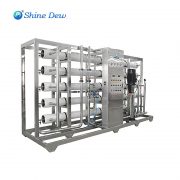
Think of RO as a supremely selective membrane. It forces water through microscopic pores under pressure, physically blocking dissolved salts, organics, and pathogens. It’s the robust, energy-driven workhorse for producing safe, consistent drinking water, perfectly suited for brands where a controlled mineral profile is key. Our ShineDew RO-5000L System exemplifies this, reliably serving medium-capacity mineral water production.

EDI, however, operates on an electrochemical principle. It uses direct current to continuously regenerate ion-exchange resins, splitting water molecules to create H+ and OH- ions that displace and flush out mineral ions. This chemical-free process polishes water to ultra-pure levels, ideal for applications requiring near-zero dissolved solids or for brands targeting the highest purity standards.

The Strategic Choice:

Opt for RO to craft natural mineral water or premium purified drinking water with desired mineral content.

Combine RO+EDI when your target is laboratory-grade purity or you supply industries with stringent ionic contamination limits.

At ShineDew, we help you navigate this critical decision—not with a one-size-fits-all solution, but with the precise technology for the water you envision.

How RO Membranes Achieve 99% Contaminant Rejection

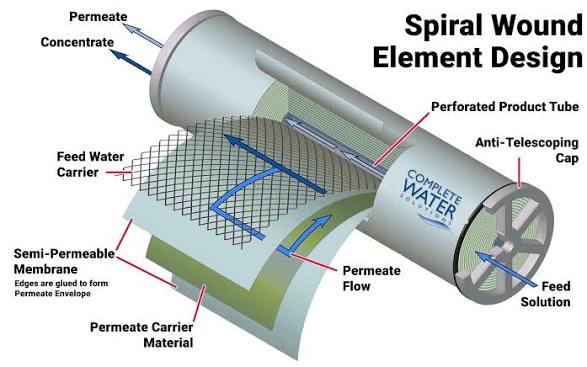
The essence of reverse osmosis (RO) membrane technology is a reverse breakthrough of the natural osmosis phenomenon. By applying an external force exceeding the osmotic pressure (usually 6 to 20 kilograms of pressure), water molecules in the water source are forced to pass through the semi-permeable membrane with selective permeability in the opposite direction, while dissolved solids, organic matter and microorganisms and other pollutants are retained and discharged. The core lies in the precise structure of the membrane material – the surface of the polyamide composite membrane presents nano-scale concave-convex wrinkles, and the transmission channels formed by these wrinkles have the dual functions of size screening and charge repulsion.

The removal capacity of modern RO membranes for specific pollutants shows differentiated characteristics: the retention rate for divalent ions (such as sulfate) can reach 99.7%, and the retention rate for monovalent ions (such as chloride ions) is approximately 95-98%. This difference stems from the interaction between the ionic hydration radius and the charge intensity. It is worth noting that the removal of free small molecule substances (such as boron and nitrate) by RO membranes requires special membrane materials or process combinations to be achieved.

In actual system design, the anti-pollution performance of membrane elements directly affects the operating cost. The anti-pollution film adopted by ShineDew reduces the surface roughness of the film (Ra value ≤40nm) and introduces a hydrophilic modification layer, making it difficult for pollutants to adhere. In combination with its intelligent control system, the recovery rate (50-75%) is dynamically adjusted according to the influent water quality, ensuring the membrane life while maximizing the water production efficiency. This combination of technologies reduces the system cleaning frequency by 40%, significantly enhancing operational economy.