
Precision vs. Efficiency: A Comprehensive Guide to Labeling Technology in the Water Industry
In the water equipment industry, the post-filling labeling process is often regarded as the “final finishing touch.” The choice of a labeling machine relates not only to aesthetics but also directly impacts production line automation and long-term operational costs. Currently, mainstream equipment in the industry revolves around the adhesive sticker Labeling Machine and the OPP hot glue Labeling Machine.
Core Process: Scientific Principles of the Two Adhesion Technologies
A. Adhesive sticker Labeling Machine
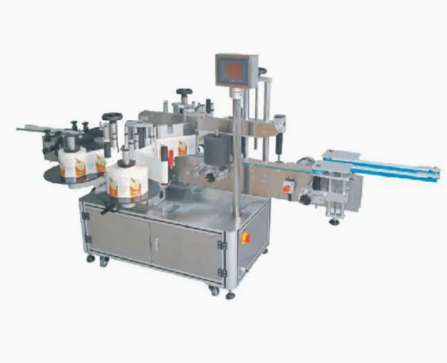
This process is akin to high-precision “peeling and transferring.” The labels consist of face stock, adhesive, and a liner. During operation, the peel plate separates the label from the liner, and a mechanical pressing mechanism applies it to the bottle. Since adhesive labels are pre-coated, they offer exceptional cleanliness and stability, eliminating issues like glue leakage or overflow. This is particularly suitable for PET or premium glass bottles requiring high transparency.
B. OPP hot glue Labeling Machine
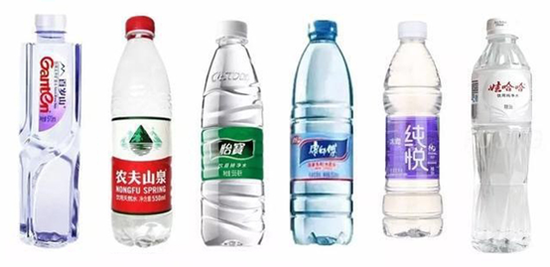
This technology utilizes an “on-line gluing” model. It uses roll-fed OPP or BOPP film, which is suctioned and cut by a vacuum drum. A glue roller then applies hot melt adhesive to the leading and trailing edges of the label. The scientific core of this process lies in thermal management; the glue temperature must be precisely controlled to maintain strong initial tack during high-speed rotation. Due to the low cost of OPP film, it is the preferred solution for mass-market drinking water (e.g., 550ml retail water).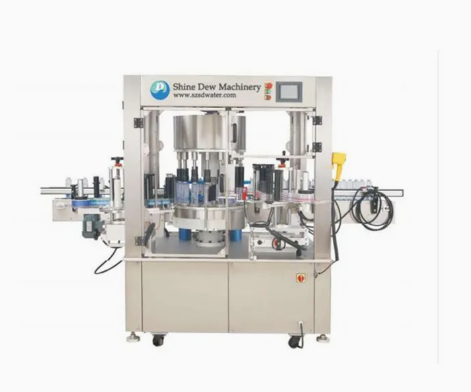
Path Logic: Fundamental Differences Between Linear and Rotary Types
In terms of mechanical paths, Linear and Rotary types represent two entirely different design philosophies, creating a watershed in “positioning” (orientation) capabilities.
Linear Labeling Machine:
Bottles pass the labeling head in a straight line on a conveyor. While compact and easy to operate, its fatal drawback is the inability to achieve precise orientation. Since bottles are free-moving or semi-fixed, the labeling head applies labels blindly, failing to ensure that labels avoid mold lines or align with specific bottle patterns or caps.
Rotary Labeling Machine:
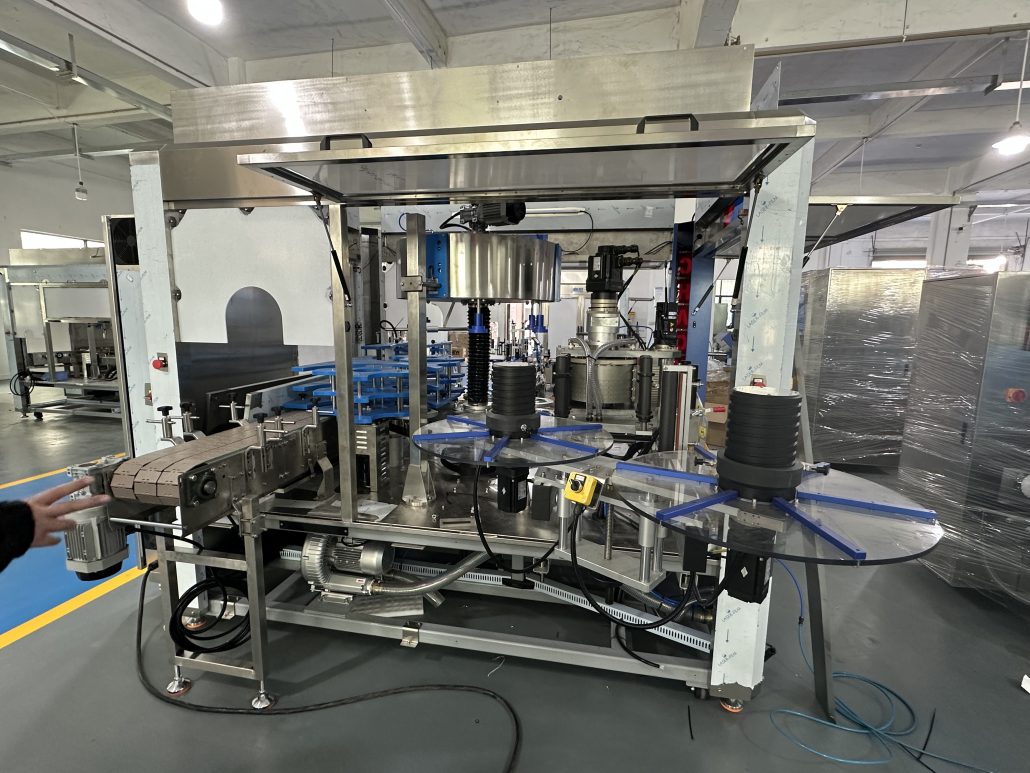
Once bottles enter the machine, they are fed into a high-speed carousel and fixed by individual pedestals. The ingenuity of this design is that each pedestal can rotate independently based on preset programs. Combined with electronic cams or vision systems, the machine can identify features (such as notches, handles, or embossed logos) to achieve 100% precise orientation labeling. This is vital for premium products demanding brand consistency.
Global Perspective: How to Choose Based on Region and Product?
In procurement, a multi-dimensional trade-off based on Return on Investment (ROI) is required:
Regional Differences: In cost-sensitive markets like Southeast Asia, Africa, and Latin America, the OPP hot glue Labeling Machine is the dominant force. Its consumable cost is approximately 1/3 that of adhesive stickers, effectively reducing the per-bottle cost. Conversely, in Europe, North America, and Tier-1 cities in China, the adhesive sticker Labeling Machine is gaining market share due to its aesthetic appeal and adaptability to complex bottle shapes.
Target Audience: For high-volume, low-margin products, hot melt technology is the first choice. For premium baby water, medical-grade purified water, or high-end soda, the “no-label” look and high-transparency visuals provided by adhesive stickers better meet the psychological needs of middle-class consumers.
Industry Advancement: The Rise of Hybrid Labeling Machines
To address diversifying market trends, the industry has developed Hybrid Labeling Machines (Adhesive sticker + OPP hot glue). This equipment integrates two labeling modules while sharing a single infeed and rotary system.
This “two-in-one” design achieves production flexibility: a factory can run large-volume hot melt OPP products in the morning and, with a simple module switch and program recall, produce high-end adhesive sticker gift water in the afternoon. This not only saves floor space but also provides technical support for strategic adjustments across different market cycles.
After ten years in the field, I believe that equipment selection is not a simple comparison of specifications—it is a decision based on a deep understanding of the product life cycle.


Leave a Reply
Want to join the discussion?Feel free to contribute!